I’m not a robot. Am I? An illustrative case study of the digital human industry
Popularity is not the same as investability. Through an illustrative acquisition case in the digital human industry, this article explores the risks behind a virtual influencer's popularity, from audience authenticity and engagement to business scalability, commercial dependency and long-term value.
Kinga Forró
Digital Business Analyst
It all starts with a face. But a face alone can’t build influence. Personality does. So, is it really that strange to give a virtual entity one? Look no further than the digital human industry.
Digital is a different stage, a kind of connective tissue that links interactions, revealing whether audiences recognise a character, trust its voice, and engage with its story.
Consider an illustrative $60 million acquisition opportunity involving a digital human-focused company with five million followers and a flagship virtual influencer collaborating with international brands. What exactly is an investor buying: a popular digital character or a scalable business?
The digital human sector encompasses a range of business models. Companies such as Synthesia, ValkaAI, Higgsfield and AvatarOS operate across areas including enterprise AI avatars, interactive digital humans and AI-powered content production. While not direct comparables, they illustrate the different ways technology can support the creation and commercialisation of digital identities.
For investors, the challenge arises when a company presents itself as a scalable technology platform, while much of its commercial success still depends on a single virtual character. Digital due diligence examines audience authenticity, engagement quality, platform dependency and commercial transferability to assess whether a business can scale beyond its flagship character.
The following illustrative case explores how these factors can influence valuation.
Let's keep this one real.
Illustrative case
An investor plans to acquire a 60% stake in a European virtual-human company at an enterprise value of $60 million. The target owns a flagship virtual influencer and produces campaigns for international fashion, technology and consumer brands.
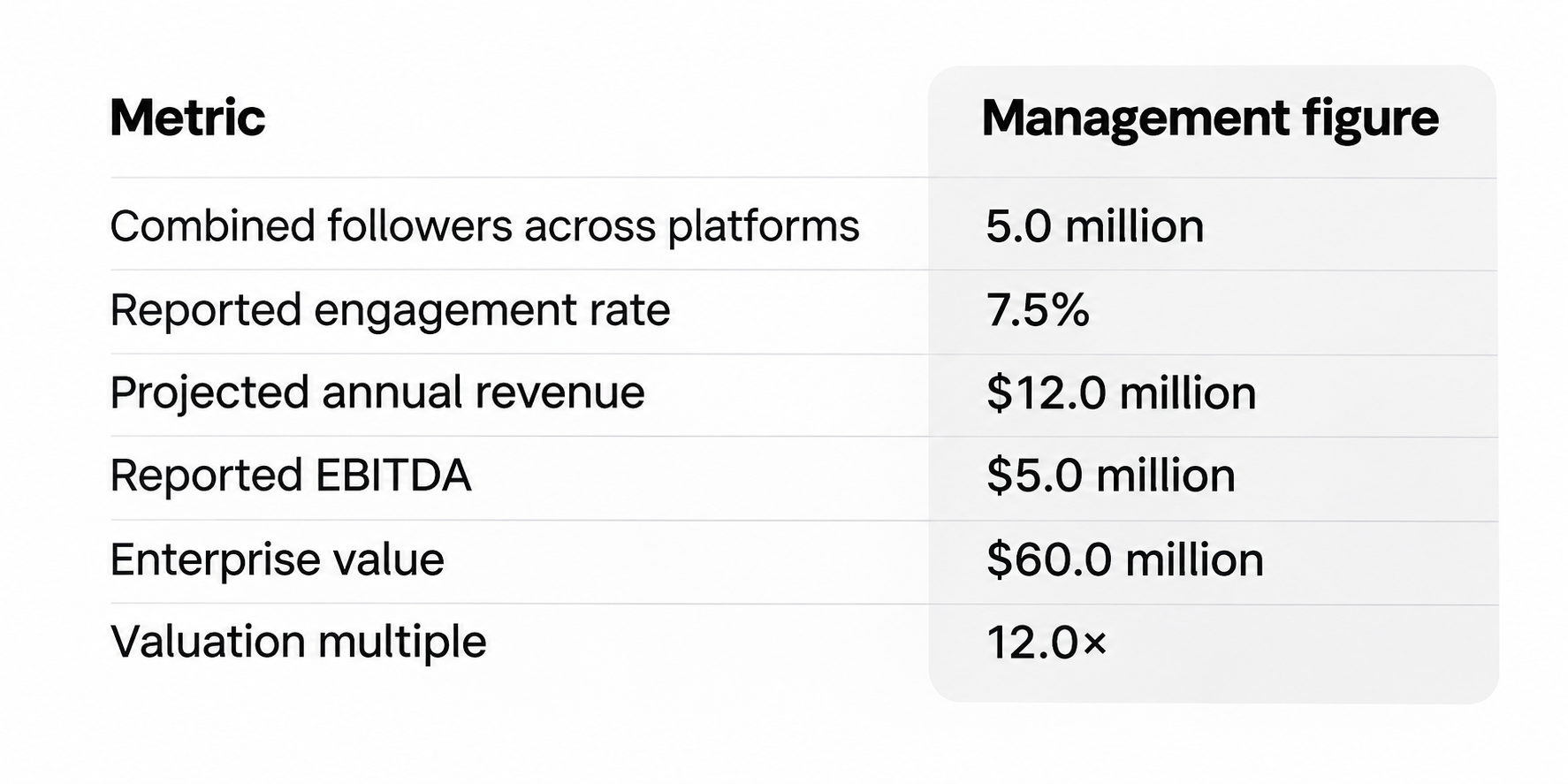
Management presents the following metrics:
Traditional due diligence confirms the ownership of the character IP, brand contracts and historical revenue. Digital due diligence, however, identifies four risks:
Audience inflation: 30% of followers overlap across platforms, 20% of the remaining accounts are inactive or suspicious, and only 65% match priority markets.
Engagement risk: Authentic engagement recalculates to 3.6%, compared with the reported 7.5%, following validation of audience and interaction quality on a comparable measurement basis.
Platform dependency: 68% of verified reach comes from one platform, leaving distribution exposed to algorithm changes or platform policy decisions.
Limited transferability: 72% of attributable campaign interactions come from the flagship character, while the performance of newer characters remains unproven.
Together, these findings suggest that the target's commercial influence may be more concentrated and less transferable than its headline metrics imply.
Applying the audience-quality adjustments sequentially, the estimated commercial audience becomes:
5.0 million × 70% unique × 80% credible × 65% commercially relevant = 1.82 million
Under these illustrative assumptions, only approximately 36% of the headline audience qualifies as unique, credible and commercially relevant. This represents an adjusted audience estimate rather than a direct reduction in revenue or enterprise value.
The implications extend beyond audience quality. Following the digital review, financial due diligence confirms that $1.4 million of recurring rendering, API, editing and moderation costs had been treated as exceptional. Commercial due diligence also confirms that most campaign revenue depends on the flagship character and that only 20% of revenue is recurring platform income.
Normalised EBITDA consequently falls from $5.0 million to $3.6 million.
At the unchanged asking price:
$60 million enterprise value ÷ $3.6 million normalised EBITDA = 16.7× EBITDA
The original valuation of 12.0× reported EBITDA therefore increases to 16.7× normalised EBITDA, even before adjusting for the digital risks identified.
To reflect the target's audience quality, platform dependency and transferability risks, the investor applies an illustrative risk-adjusted multiple of 8.0× normalised EBITDA. This multiple is a hypothetical underwriting assumption, rather than a figure mechanically derived from the digital due diligence findings, and illustrates how lower scalability and higher perceived risk could influence valuation.
$3.6 million normalised EBITDA × 8.0 = $28.8 million illustrative revised enterprise value
Assuming no net debt, no other equity value adjustments and a proportional valuation of the stake without a separate control premium, 60% of the revised equity value equals approximately $17.3 million, compared with $36 million under the original valuation.
The findings indicate that the original valuation does not fully account for the risks associated with audience quality, platform dependency and concentrated commercial performance.
The investor insight
While the company has the technology to create and manage digital identities, only 20% of its revenue comes from recurring platform income, and 72% of attributable campaign interactions are generated by its flagship influencer. Its ability to replicate that success across other characters remains unproven.
Digital due diligence brings this dependency into focus, while financial and commercial due diligence help translate it into a more realistic assessment of earnings, scalability and valuation.
The buyer would be valuing the business as a scalable technology platform, while much of its commercial performance remains dependent on a single digital character.
Each month, our newsletter brings a new selection of topics, ideas and perspectives worth exploring. Join us for the next edition.
We’re curious in which car do you see yourself taking this roadtrip. If you need a helping hand figuring out the road to grow, check out our Consultancy services and don’t hesitate contacting us.
Explore the true potential of your digital endeavours
When was the last time you lost sight of a seemingly minor detail that kicked back? While thinking about it, check out how we can help you with uncovering the digital opportunities and risks that were not evident from the start.