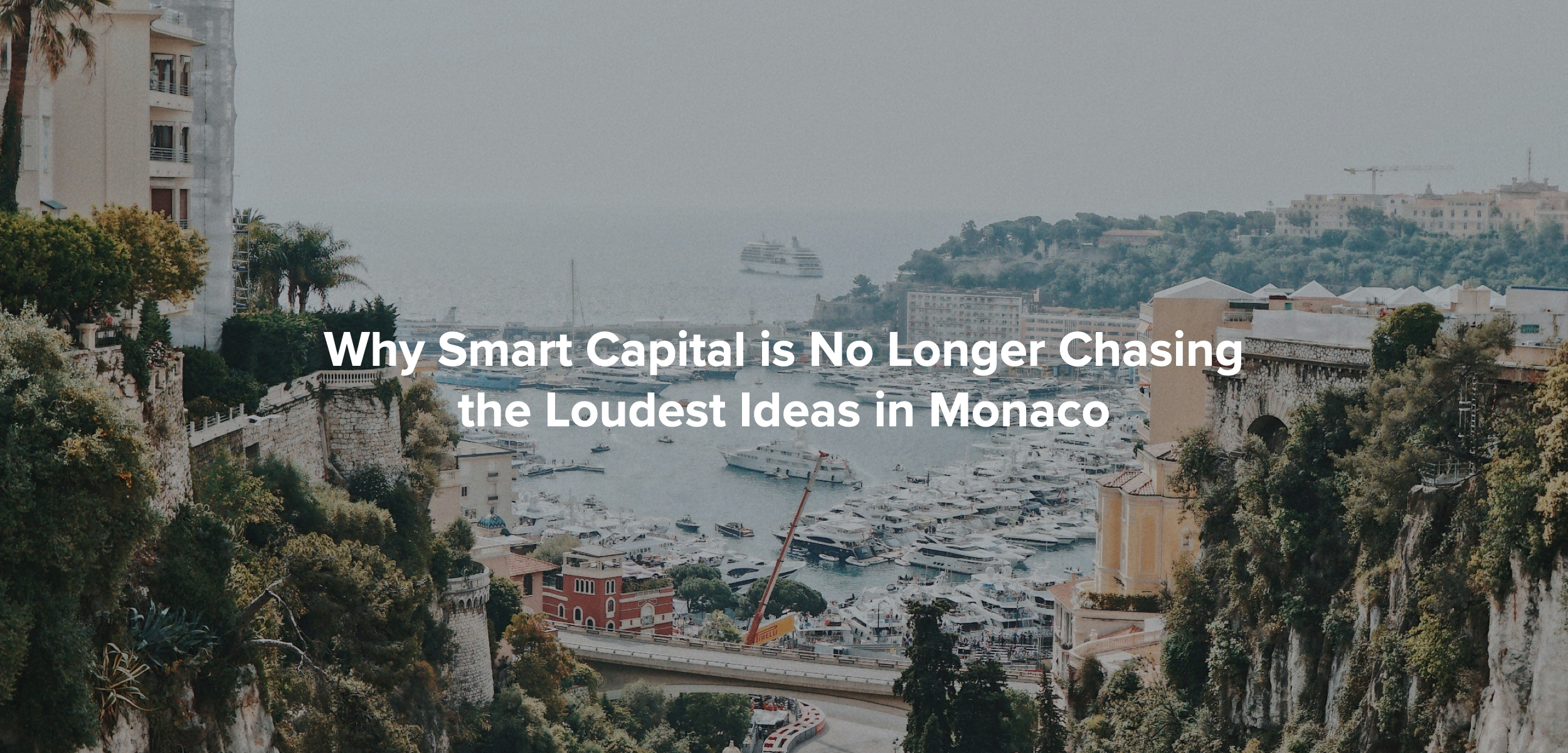
Why Smart Capital is No Longer Chasing the Loudest Ideas in Monaco
The investment landscape is changing. Monaco is one of the rare rooms where capital and performance rise to a new level, revealing insights we don't read anywhere else. In this article, we offer a window into this world where narratives have become abundant, and smart capital is increasingly looking for evidence instead.
Kinga Forró
Digital Business Analyst
Monaco is a statement before anyone in the room says a word. The cars, the yachts, the hotels, the watches, the access, everything signals something. Wealth, obviously. But also proximity: to capital, to influence, to people who can turn a conversation into a company, a fund or an acquisition.
Spend enough time there during Formula 1 weekend and another thing becomes obvious. In a place built around signals, you become unusually sensitive to the difference between a signal and the thing it is supposed to represent.
That was probably our biggest takeaway from Monaco this year. Not a prediction about markets, and certainly not a claim that a few days of conversations can explain where global capital goes next. This is a more personal account of what we learned, what kept coming up, and what we found ourselves thinking about on the way home.
The conversations shaping tomorrow’s investments often sound surprisingly different from the headlines describing today’s. AI was everywhere, of course. So were robotics, defence, biotech, energy and longevity. But beneath the sectors and the pitches, the same question kept resurfacing:
How do you tell the difference between a business that is executing and a story that has simply become very good at looking like one?
The answer matters because capital has not disappeared. It has become harder to impress.
Investors are asking tougher questions about resilience, execution and whether a business can create lasting value. The interesting part is that these questions are also changing some of the old assumptions about what constitutes risk in the first place.
Four ideas kept coming back to us:
What we call “safe” is changing
Narrative has become cheap, while evidence remains expensive
The best opportunities often appear before they become obvious
Genuine brave capital means having conviction before consensus, without abandoning discipline.
1. Safe No Longer Means What It Used To
For a long time, “safe” in investing had a fairly intuitive meaning. Buy the thing with history, buy the asset people understand, or buy stability. That logic worked particularly well in a world where the underlying rules changed slowly. The problem is that the rules no longer seem especially interested in changing slowly.
Regulation, geopolitics and technological disruption are reshaping multiple sectors at the same time. One theme we heard repeatedly in Monaco was that risk is becoming less about the label attached to an asset and more about its ability to adapt. A traditional asset exposed to structural regulatory pressure may now carry more long-term risk than a deep-tech business with defensible intellectual property and strategic demand.
Take UK residential property. For years, it looked almost like the definition of a conservative investment: understandable, tangible, historically resilient. But understandable and low-risk are not synonyms. Regulatory changes affecting landlords, possession, costs and predictability have altered the risk profile. The house has not physically changed. The system around it has. And the reverse is happening elsewhere. Some things that still look speculative are steadily becoming less so.
Precision medicine. Advanced materials. Robotics. New energy systems.
Public perception tends to update slowly. Technology does not always have the courtesy to wait for it. Companies such as NVIDIA and Moderna are useful reminders of this pattern. Their underlying capabilities developed for years before the scale of their commercial importance became obvious.
By the time everyone agrees that technology matters, the investment question has usually changed from “is this real?” to “how much of the upside is left?”
Biotech is particularly interesting here. We are moving toward therapies that do not simply attack a category of disease, but respond to the biology of an individual patient. BioNTech, for example, has been combining mRNA technology with AI-assisted target selection in personalised cancer immunotherapies. AI can help identify promising tumour-specific targets from genomic data. mRNA technology can then make it possible to design personalised vaccine candidates much faster than conventional drug-development models historically allowed.
What interests an investor is not only the headline breakthrough. It is the layer immediately below it. The companies that take something from “it works” to “it works reliably, repeatedly and at scale.” That distinction matters far beyond biotech.
Advanced materials may change how we generate and store energy. Robotics reshape labour economics. Longevity moves from treating disease to delaying its onset. Space infrastructure creates markets that currently sound more like engineering problems than asset classes.
None of these sectors develops neatly around a quarterly earnings calendar. Science has its own clock. And that leads to a different definition of safety.
Safety is increasingly not the absence of change. It is the ability to survive, or benefit from, change.
2. Narrative Has Become Abundant. Evidence Has Become Scarce.
This may be the most important change of all. The cost of creating a convincing story has collapsed.
A competent founder can produce a beautiful deck quickly. AI can sharpen the language, design the slides, build the model, generate market research and make almost any proposition sound coherent.
The cost of actually building the company has not collapsed with it, creating an unusual asymmetry.
Stories are becoming better faster than businesses are becoming better, which means investors are no longer simply competing to find compelling narratives. They are competing to determine which narratives correspond to operational reality.
This is where Digital Due Diligence becomes interesting to us. Every operating company leaves traces. Hiring can reveal a sudden build-out in AI, semiconductor or specialised engineering roles. Engineering output can show up through open-source contributions, patents and technical publications. Product momentum appears in release frequency and shorter development cycles. Partnerships, customer adoption, retention, reviews, conference appearances and even technical discussions in developer communities can all contribute additional pieces of evidence.
Individually, these signals can be noisy. Viewed together, they begin to tell you how a company actually operates often before that reality becomes obvious in a financial report.
If a semiconductor company claims to be moving toward production, what does its hiring say?
If an AI business says enterprise demand is accelerating, is there evidence of deployment?
If a supposedly deep-tech company claims a technical moat, what does its engineering footprint look like?
Financial statements tell you what a company has already become. Digital evidence can sometimes show you what it is in the process of becoming. That distinction matters even more because fraud has improved along with legitimate storytelling. The Medvi case is an uncomfortable example of where this can lead. AI-generated conversations, deepfaked endorsements and investment platforms designed to appear completely legitimate show how quickly the line between authentic and synthetic credibility is disappearing.
In a world where almost anything can be made to look credible, looking credible is no longer much evidence at all.
The Japanese distinction between tatemae and honne feels useful here.
Tatemae is the face presented to the world. Honne is what is actually true underneath.
Every investor, whether they use those words or not, is trying to close that gap.
And the economics of venture investing make getting it wrong particularly expensive.
Venture returns follow a power law. A relatively small number of investments generate a disproportionate share of total returns, while a large percentage fail to return invested capital. Correlation Ventures and Horsley Bridge data, for example, suggest that roughly 65% of venture investments fail to return the original capital invested. Only a very small proportion generate the exceptional outcomes that ultimately drive overall fund performance. Cambridge Associates’ benchmark commentary points in the same broader direction: venture returns remain highly uneven across the asset class.
The precise numbers vary by dataset and vintage, but the underlying point is less controversial. Venture is not a game where every reasonable-looking company produces a reasonable return. A handful of exceptional outcomes do much of the work.
That makes verification unusually valuable.
When stories are scarce, storytelling is an edge. When stories are abundant, verification becomes the edge.
3. The Biggest Opportunities Rarely Begin With Consensus
You cannot spend much time around investors today without talking about AI. It is the gravitational centre of the conversation and understandably so. But something struck us in Monaco: almost everyone wants exposure to AI. Far fewer people begin by asking what AI needs in order to exist.
That question is often more interesting.
Every technological revolution creates a stack beneath the thing consumers see. Behind AI sit semiconductors, electricity, data centres, cooling, networking, storage, robotics and advanced manufacturing. The application gets the headline. The infrastructure receives the purchase order.
Schneider Electric is a useful example. It does not need to build the next ChatGPT to benefit from AI adoption. As computing requirements grow, data centres need increasingly sophisticated power distribution, cooling and energy-management infrastructure.
There is also an important difference in risk profile. An application-layer AI company may find its product disrupted by the next generation of models surprisingly quickly. Infrastructure providers such as Schneider supply engineering capabilities that the broader ecosystem requires regardless of which individual AI product ends up winning.
If the gold rush gets bigger, you can bet on the miner. Or you can ask who sells something every miner eventually has to buy. The old “picks and shovels” analogy survives because the economics behind it survive. Today's shovels include semiconductors, energy infrastructure, data centres, networking, storage and advanced manufacturing.
Foundation models illustrate the point nicely. Models such as those behind ChatGPT, Claude and Gemini are trained on enormous datasets and computing infrastructure. Building and competing at that layer has become one of the most capital-intensive contests in technology. Training state-of-the-art models requires extraordinary amounts of computing infrastructure and capital. The competition is enormous and the ultimate economics of many application-layer businesses remain uncertain. But whichever model wins, electrons still have to reach the chips, data still has to move, and heat still has to leave the building.
That is often where an interesting investment thesis starts.
Not with: What is everyone talking about?
But with: What does the thing everyone is talking about inevitably require?
AI is already changing assumptions about electricity demand and driving additional investment and debate around nuclear power, including small modular reactors, grid capacity, storage and data infrastructure. It is also forcing new approaches to data transfer, computing infrastructure and the physical systems required to run an increasingly digital economy.
These opportunities are not exactly hidden. They are just simply less glamorous. And that distinction matters, because by the time an opportunity feels completely obvious, you are usually no longer early. The challenge is learning to distinguish between uncertainty caused by genuine weakness and uncertainty caused by a market that has not caught up yet.
That is a much harder question than following consensus. It is also where much of the upside lives.
4. Brave Capital Invests Before Consensus
“Brave capital” can sound dangerously close to a euphemism for reckless capital. That is not what I mean by it. To me, brave capital is informed conviction. It is being willing to fund something difficult before the market has completely agreed that it is sensible, but having enough evidence to explain why you are doing it.
There is still plenty of capital willing to take risk, but it has clustered. AI attracts enormous attention. So do parts of defence and robotics. Meanwhile, equally consequential fields still struggle to attract patient money. And patience itself seems to have shortened.
Scientific breakthroughs used to be understood as things that might take decades. Today, even frontier technology is sometimes discussed as though it should fit neatly inside a five-year fund model. Physics does not care about a fund’s exit horizon. Biology is not especially interested in your next board meeting.
So where is brave capital actually needed?
Can robotics reduce labour shortages without simply creating a new category of social problems?
Can space-based manufacturing eventually move resource-intensive processes away from Earth?
Can energy become abundant without relying permanently on fossil fuels?
Can medicine shift from extending lifespan to extending healthy lifespan?
Those are the kinds of questions I find more interesting than “what is the next AI app?”
Robotics is a good example. Today's humanoid and dexterous robots still look clumsy. That is precisely why it is easy to underestimate them. People see the robot dropping an object, an engineer sees another training example. Millions of human movements are quietly becoming training data, helping machines learn to grasp, manipulate and interact with objects with increasing precision.
The systems improve. Hardware improves. Models improve.
The question is becoming less “will robots ever be dexterous?” and more “how quickly does the capability curve improve from here?” What looks awkward today may simply be what exponential technology looks like before the curve becomes obvious. A concrete example comes from Budapest. Allonic recently raised funding to industrialise dexterous robotic hands, with backing from angels connected to OpenAI and Hugging Face. It is one small example of a much larger pattern.
The investment question is where on that curve you become willing to believe the evidence.
What Monaco Made Clearer to Us
There is an irony in reaching these conclusions in Monaco. Few places on earth are better at presentation.
Monaco itself is a signal. Arriving there says something. Being invited into certain rooms says something else. The boat, the table, the hotel, the accreditation around your neck, everything has informational value. But informational value is not the same as truth. And perhaps that is why the distinction between narrative and reality felt especially sharp there.
You meet founders who can explain a billion-dollar market in five minutes, family offices that have seen hundreds of versions of the same pitch. Investors who know that the best opportunity in the room may belong to the person speaking least. Policymakers discussing industries whose regulatory frameworks have not caught up with the technology.
You start noticing not just what people are excited about, but what they are quietly sceptical of. And the recurring scepticism was not about innovation. It was about proof.
Is the technology real? Does the team execute? Are customers actually using it? Is the moat technical or just linguistic? Does the opportunity survive contact with regulation? What has to become true for this company to work, and how much of that is already true today?
Those are much better questions than asking whether a pitch sounds exciting.
Final Thoughts
We left Monaco less convinced by narratives, not more cynical about innovation. There is a difference.
Capital is still looking for opportunity and there is no shortage of money willing to fund the future. What appears to be getting scarcer is credibility. In a market where a persuasive narrative can be manufactured almost instantly, investors have to work harder to establish what is underneath it. That changes the nature of due diligence. Digital Due Diligence is one part of that shift.
It is not a crystal ball. It is simply another way of refusing to take the presentation at face value. Hiring, engineering activity, customer behaviour, technical output, partnerships and product cadence can help build a more complete picture of what a company is actually doing. And that matters because the most interesting opportunities will rarely arrive labelled as obvious.
Some will look risky because they genuinely are, while others will look risky because the market is still using yesterday's definition of safe.
Some stories will sound extraordinary because the underlying company is extraordinary, while others will sound extraordinary because telling extraordinary stories has never been cheaper.
The investor's job is to know the difference, and perhaps that is the real meaning of brave capital:
not capital that believes everything early, but capital that knows what evidence it needs in order to believe something before everyone else does.
We’re curious in which car do you see yourself taking this roadtrip. If you need a helping hand figuring out the road to grow, check out our Consultancy services and don’t hesitate contacting us.
Explore the true potential of your digital endeavours
When was the last time you lost sight of a seemingly minor detail that kicked back? While thinking about it, check out how we can help you with uncovering the digital opportunities and risks that were not evident from the start.