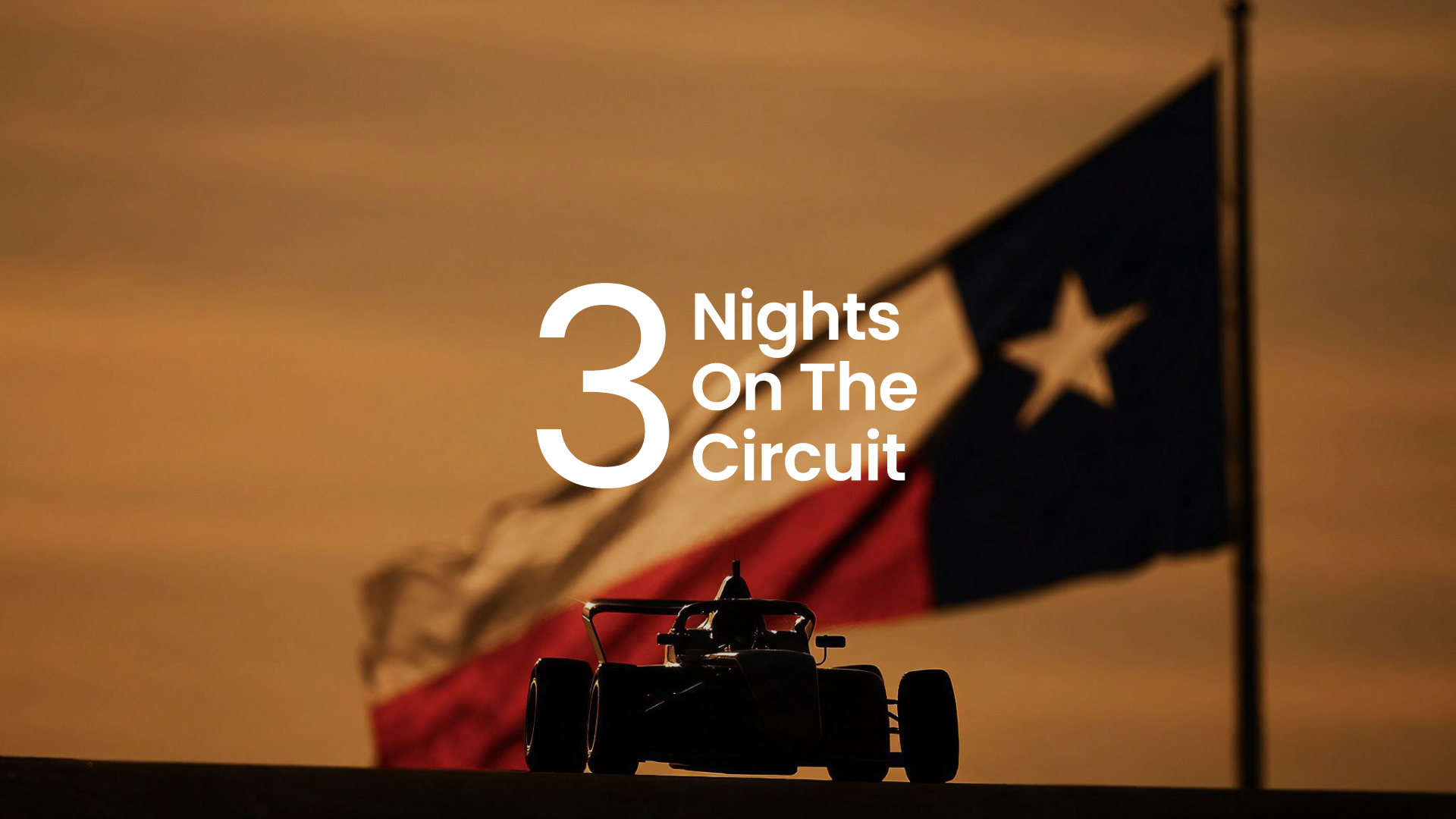
Ahead of Formula 1’s arrival in Austin, Cognitive Creators joins THREE NIGHTS ON THE CIRCUIT as an investor insights and digital data partner, exploring teams, narratives and digital signals defining the sport’s next commercial chapter.
Kinga Forró
Digital Business Analyst
There is something compelling about the number three: “Third time’s the charm”, three acts shape a story, or three wishes spark possibility. Formula 1’s American story also comes in threes. The sport visits Miami, Austin and Las Vegas, each representing a different dimension of its commercial appeal: Miami through lifestyle, Austin through racing, culture and live entertainment, and Las Vegas through spectacle.
When the focus turns to Austin in October, the idea of three moves from the racing calendar into the city itself. Beyond the circuit, Crowley Capital and Texas House will host THREE NIGHTS ON THE CIRCUIT, an invitation-only experience created for a highly curated community of family offices, private investors, CEOs, senior executives, strategic partners and cultural leaders. The program moves through three distinct settings: an intimate Thursday dinner for 60 guests, a Friday event for up to 2,000 with elevated hospitality and live entertainment, and a 500-person VIP circuit experience on Saturday. More than a race-weekend gathering, it is designed to give influential leaders the time and access needed for introductions to develop into meaningful relationships.
This year, Cognitive Creators will join the event as its investor insights and digital data partner.
Formula 1 is exceptionally good at generating attention. But who captures that attention, who retains it, and who can ultimately turn it into value? Digital signals allow us to follow that journey, from the moments when interest peaks, to the teams that attract it, and the emerging channels shaping future discovery.
What follows is an opening view of that landscape.
Formula 1’s global attention engine
Not long ago, Formula 1 primarily spoke to committed motorsport enthusiasts. Today, it operates at the intersection of sport, entertainment, technology, fashion and popular culture.
The transformation has been significant. Our analysis of F1’s digital growth estimates that global online interest in F1 has risen by roughly 13.5% since 2020. Search interest in F1 TV increased by 77.5% between 2021 and 2025, while the sport’s combined social media following continues to grow by around 21% annually.
Those numbers matter, but the change underneath them matters more.
F1 has learned how to turn a race into a year-round narrative. Fans may enter its world through engineering, a driver, a Netflix series, a fashion collaboration or a clip of team radio. Once they arrive, the sport gives them another story, platform or personality to explore.
That is what makes modern Formula 1 so commercially compelling. Its growth does not depend on every audience caring about the same thing. It works because different audiences find different points of relevance in the same world.
Formula 1 has built the attention engine. The next question is when that attention becomes most visible.
When attention appears: The Grand Prix-level view on Miami, Austin and Las Vegas search peak
Search behaviour around Formula 1’s three US races in 2025 demonstrates how strongly attention is tied to individual race weekends. Miami generated the highest relative search peak, with Las Vegas following closely. The United States Grand Prix in Austin produced a lower, but still clearly concentrated rise in global interest.
The shape of these peaks is as revealing as their relative size. Public attention builds rapidly as a race approaches, reaches its height around the event and then recedes almost as quickly. For brands, this creates a narrow but valuable window. The opportunity is not simply to maximise visibility during the race, but to convert that temporary surge into continued discovery, sustained engagement and commercial interest after the weekend ends.
Race-level data tells us when attention appears. The next question is where it goes.
Where attention goes: the team-level view. Which teams attract the strongest search demand?
Team-level analysis reveals how public attention is distributed across Formula 1’s leading brands and which teams may be best positioned to retain it.
Branded search demand shows where audience interest already exists. AI visibility provides an emerging signal of which teams are most discoverable as search behaviour evolves. Looking at the two together reveals where established demand and future discoverability reinforce each other, and where unrealised digital growth potential may remain.
The comparison reveals different forms of digital strength rather than a single leader. McLaren and Red Bull Racing generate the strongest branded search demand, with Red Bull also leading in AI visibility. Ferrari combines enduring search interest with strong discoverability, while Aston Martin performs particularly well in AI relative to its search volume. Mercedes-AMG Petronas remains one of the sport’s most recognised brands, yet its position in this comparison shows that historical scale does not automatically translate into leadership across every digital channel.
The picture is not simply about who leads today, but about how effectively each team can translate momentum, heritage and discoverability into a direct and durable relationship with its audience.
Teams that combine strong branded demand with high AI visibility may be better positioned to convert attention into long-term brand equity. Where those signals diverge, the gap may indicate an opportunity: existing brand strength that has not yet been fully translated into emerging discovery channels, or strong visibility that still has room to develop into broader demand.
For investors, that distinction matters. Digital strength is the relationship between current interest, future discoverability and the ability to retain attention over time.
Who turns attention into value: The investor-level view
Ultimately, this is the question behind every investment in sport: how much of today’s evidence can be translated into tomorrow’s value?
The most valuable lap in Formula 1 is the one that has not yet been driven. Past performance creates evidence, future potential creates value.
For investors and teams, that means assessing a future neither can guarantee alone. Data cannot eliminate uncertainty, but it can improve the quality of the decisions made within it. Relationships can influence those decisions too, bringing together capital, insight and operating capability around the same opportunity.
Formula 1 provides an example of how modern attention moves. It builds quickly, travels between races, teams, drivers and narratives, and increasingly flows across search, social platforms and AI-driven discovery.
The commercial question is what happens next: who can capture that attention, who can retain it, and who can turn it into something durable?
That is the perspective we will bring to THREE NIGHTS ON THE CIRCUIT in Austin: looking beyond the loudest moments to identify the digital signals that may continue creating value long after the engines fall silent.
We’re curious in which car do you see yourself taking this roadtrip. If you need a helping hand figuring out the road to grow, check out our Consultancy services and don’t hesitate contacting us.
Explore the true potential of your digital endeavours
When was the last time you lost sight of a seemingly minor detail that kicked back? While thinking about it, check out how we can help you with uncovering the digital opportunities and risks that were not evident from the start.